Our Science
Tissue fluidity, or the ability of cells to move, flow, and rearrange within a tissue, is a fundamental physical property of all multicellular life. Every tissue that has ever existed has it’s own characteristic fluidity, where some tissues are more solid-like, where cells are constrained in place, and others are more fluid–like, where cells are free to move.
Despite the universal importance of tissue fluidity, know very little about how it is biologically controlled. One major goal of our lab is to understand the molecular, cellular, and tissue-scale mechanisms that can be regulated to control tissue fluidity. We use a combination of molecular screening approaches, advanced imaging, AI/ML, and multi-scale biophysical modeling.
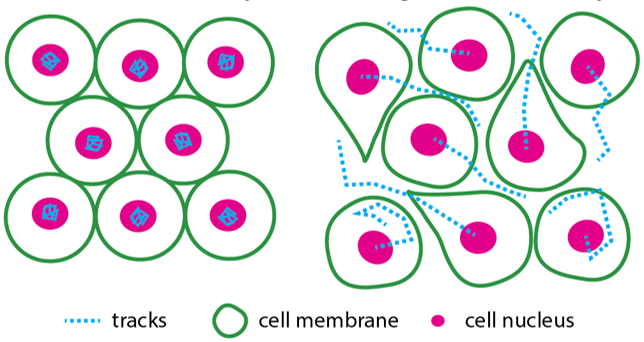
Tissue fluidity is a universal physical property of all multicellular life
Tissue fluidity as a master regulator of multicellular patterning
Our recent work has demonstrated that tissue fluidity acts as a critical regulator of multicellular patterning, and can readily be tuned to freeze, catalyze, or erase multicellular patterns. Under low fluidity, patterns are frozen because cells can’t move; under high fluidity, cells mix randomly to erase existing patterns; while an intermediate tissue fluidity can allow patterning to proceed rapidly and accurately.
Our lab seeks to elucidate the design principles governing the interplay of tissue fluidity and patterning across diverse natural and synthetic contexts. We are exploring how tissue fluidity controls the rate and accuracy of tissue patterning during embryonic development, as well as engineering tissue fluidity to optimize the design of synthetic tissues.
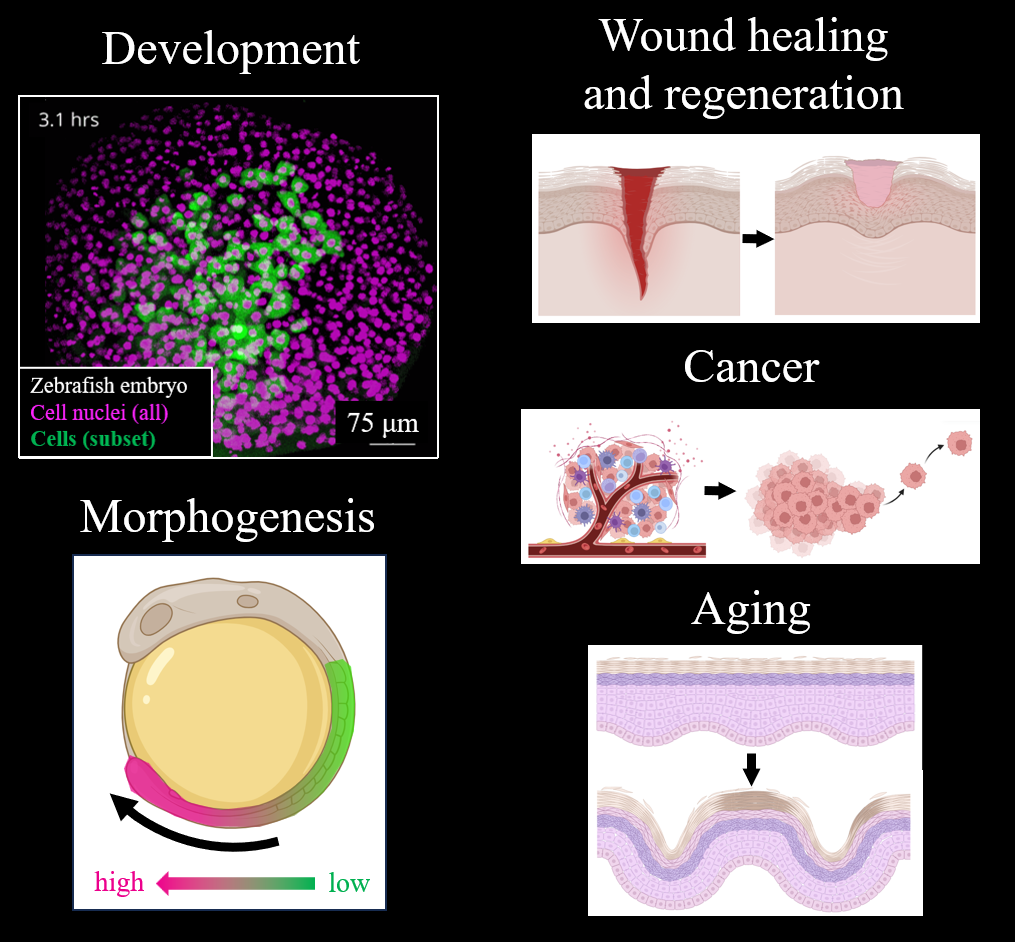
Tissue fluidity in health and disease
Recently, modern time lapse imaging approaches have made it clear that tissue fluidity plays major roles across a wide range of healthy and disease contexts. During development, gradients of tissue fluidity drive major morphogenic events such as body axis elongation. In wound healing, solid tissues actively fluidize to allow cell rearrangements required to close the wound.
Mis-regulated fluidity has also been implicated in various diseases, including cancer, where tissue fluidization promotes metastasis, and tissue solidification is also prevalent in aging.
Our lab seeks to collaborate broadly to explore how tissue fluidity can be therapeutically manipulated to generate, re-generate, and rewire patterns in health and disease.